I can spend 4 hours playing a mind-numbing game of Candy Crush but if you tell me to just open my laptop and start that new project, I'll find another way to spend another 4 hours playing Candy Crush.
Here's the odd part:
I DON'T LIKE CANDY CRUSH.
Anddddd
I LOVE MY WORK!
So for the last, oh thirty years, I've spent right about every minute hating myself for not doing what needs to be done to get where I know I have the potential to go.
Okay, given, I genuinely didn't believe I was meant for anything big for about half my life. Reasons were simple:
✅ I was average at best in academics -
It was a miracle if I could scrape 80 in my exams: a big point of embarrassment coming from a family of toppers.
✅ I spent more time reading Harry Potter
(over and over again) than I did reading my textbooks.
✅ I knew inherently in the deepest pits of my stomach
that I was smart but had never achieved a single thing in my life that could hold a candle to that belief - and soon that belief simply became another point of frustration where I would spend hours taking free IQ tests, scoring well, thinking I was smart, reading stuff about intelligent folks online, ticking every single trait of smart people, going to school, getting low grades, and watching that energy-cum-belief crash all over again. Basically, every single day.
✅ Also, I was an introvert,
so never being great shakes at conversation, I didn't know I could hold one. The only thing I ever remembered from any social interaction was making some mistake - crashing a plate to the floor because my hands were shaking out of nervousness, or saying something really stupid because I was reeling in mind-numbing anxiety - and then crawling into my shell all over again, fighting the two parts of my mind that couldn't seem to decide whether I was actually smart or simply delusional.
Whew. So exhausting.
Things changed when I started my first job. Primarily because it was a sales job and I was touring all the time.
And you know what happens to an introvert suddenly thrust into a sales role? IT'S HORRIBLE.
✅ Talking to people? Check.
✅ Cold calling? Check.
✅ Being confident like you know your shit? Check.
✅ Trying to sell something you know NOTHING about to someone who's been in the industry for 20 years? CHECK!
Well, I did all of that, and it didn't take long for me to realize - I WAS ACTUALLY GOOD AT IT.
Don’t get me wrong - I hated it. I still hate sales. I hate trying to sell anything to anyone - probably one of the reasons I try so hard to create value first because then your value becomes the pull product, rather than something you have to go out and sell (but more on that later… or maybe not, I don’t know)
But I’ve often wondered, especially now when I’m trying to build my business and not able to work more than maybe 20 minutes a day…
Why was it so easy to do something I hated, and why is it so hard to do something I genuinely love?
Something outside was consistently doing what I couldn’t do for myself. The question is: what?
* * *
// ACT_02: THE_SCIENCE (Bear with me!)
I came by this equation while doing my Bachelors in Chemical Engineering - the Arrhenius equation:
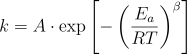
Where,
Ea is the activation energy - the minimum energy a molecule needs before it will react and transform into something new.
Before you get bored and close the tab, this isn’t an engineering blog. Stay with me.
See, the Arrhenius equation represents not just the activation energy of a chemical reaction, but also the activation threshold energy required to catalyse the mind into action.
Arrhenius argued that for any reactant to start transforming into a product, it must first acquire a minimum amount of energy.
Below that threshold? Nada. No reaction. No transformation. Just inertia.
In our day to day, the routine is the inertia. And anything new that needs to be done - from opening a spreadsheet to boiling an egg - requires kinetic energy greater than our inertia allows.
The problem isn't motivation. It's that the activation energy required to start is just too damn high.
Why does it matter to you?
Imagine it’s noon. You’re on your couch or at your office desk after a pointless morning scrum. And now, you have to attack your to-do list.
You stare blankly at the black TV screen or the god awful screensaver on your laptop, and you can’t find the strength to press a key and open that CRM that’ll sap your next few hours.
(God, I want to go to sleep just picturing this drudge :p)
And suddenly, you remember - you never finished that Goods Sorting level 435! Before you can take another breath, your phone is on, you’ve already opened the app and you’ve been playing that “super hard” level for the last 2 hours!
Oh damn. Another day gone by. Now, either the boss will yell at you or your internal voice will.
Oh well. Maybe tomorrow… Just this level, that’s all I need…
Sound familiar, Jack?
So why is it that starting work (something you’ve been doing a while now and something that might even be easy for you) is so hard, while trying over and over again to finish that one difficult level of a meaningless game is so easy?
It can’t just be because work is hard! If that were the case, why would you spend more time trying to tackle a hard level than you would breezing through easy ones?
It can’t just be that the work is boring… I mean, how much fun is it really playing Monopoly on your phone, really? Literally just pressing that one button over and over again while a man in a top hat dances across the board that’s doing stuff of its own accord with absolutely no interference from you.
So what is it?
What is it about games that completely make you lose track of time even when faced with tight deadlines and miraculously even, surrounded by work you love to do?
* * *
// ACT_03: THE_MECHANISM
How do games lower your activation energy?
The answer is still in the Arrhenius equation.
While the molecules in our body need a catalyst or higher temperature to cross the activation energy barrier, games do something far more elegant: they reduce the barrier itself.
And so our inertia stops resisting and flows smoothly into the kinetic reaction that starts the molecules colliding.
01 // ELIMINATE THE BLANK PAGE
Games introduce their mechanics gradually. Instead of overwhelming you with complicated rules, games reveal hurdles one by one, as you progress forward.
So the cognitive overhead - the energy tax of just figuring out where to start - has already been paid.
Work, by default, does the opposite. "Work on Q3 strategy." Where do you even begin? The activation energy of figuring out the first step is sometimes larger than the step itself. That overhead is friction, and friction raises the threshold.
02 // PROVIDE IMMEDIATE, LEGIBLE FEEDBACK
In chemistry, temperature is feedback. It tells molecules whether they're energetic enough to react. Games replicate this constantly: you move a tile, three pieces disappear, points go up, a small sound plays. You know in 3 seconds whether your action worked.
Work rarely does this. You write a proposal, send it, and wait three days to know if it was good. You build a feature and wait three weeks for user data. The feedback loop is so slow that your brain can't calculate whether the energy was worth it - so it defaults to not spending the energy at all.
03 // VARIABLE REWARDS TO KEEP THRESHOLD LOW OVER TIME
Behavioural psychologist B.F. Skinner showed that variable reward schedules - where you don't know exactly when the reward will come - produce the most persistent behaviour. Slot machines. Loot boxes. That one level that might drop a rare item.
Games are variable reward machines by design. Work is the opposite: a fixed, predictable grind with a paycheque at the end of the month.
Predictable rewards don't energize. They sedate.
04 // SHOW A PROGRESS BAR
Candy Crush gives you a clear map. As you finish a stage, it takes you back to the map where you volunteer to start the next set of levels. You know where you began, you know where you are, and you know how far you have to go.
Humans are wired for completion. While you can still see 2 more levels remaining for crossing the bridge, you can’t stop. You HAVE to cross the bridge. This is the Zeigarnik effect.
Work is like an endless tunnel. You don’t see where it turns, you can’t see where it’ll end, you don’t see how far away the light (aka the reward) will be or what it’ll be. So your brain searches for 5 pm as the sign of completion and the next morning’s 9 am seems like “back to the guillotine” than another day of adventure. No wonder we hate going to work!
Games aren't more fun than work. They're more engineered. The activation energy to start is lower. The feedback is faster. The reward is less predictable. The finish line is always visible. That's the whole secret.
// ACT_04: THE_FAULT
What's actually broken in how we design work?
Here's the uncomfortable truth: it's not you. Or your team.
If you've ever stared at a task list and felt paralyzed - even when the work matters to you - you've probably spent years blaming your character. Your laziness. Your lack of discipline. Your broken brain.
But what we've just described is a systems problem, not a character problem.
You are not a defective molecule. You are a perfectly normal molecule being asked to react in a system with absurdly high activation energy.
Work, as it is typically designed, is a high-friction environment:
✅ Tasks are ambiguous - no clear first step, no obvious action.
✅ Feedback is delayed - sometimes by days, sometimes by quarters.
✅ Progress is invisible - there's no bar telling you how close you are.
✅ Rewards are predictable and distant - salary at month end, review in December.
✅ The starting cost is always maximum - a blank page, an open calendar, an undefined deliverable.
These are design flaws that affect everyone. But they're easiest to see when we look at the people they affect most.
* * *
// THE_ADHD_LITMUS_TEST
ADHD brains are like a diagnostic tool for badly designed systems.
An ADHD brain requires more dopamine to initiate action - and dopamine is released in response to novelty, urgency, challenge, and immediate reward. Everything that daily work systematically removes.
Games give them that fuel instantly. Which is why the pull is almost gravitational.
And here's the critical insight: If something is difficult for an ADHD brain, it must, at least to a certain degree, be difficult for a neurotypical brain as well.
So by solving something for an ADHD brain, you’ve automatically made it a 100 times better for your average employee/user. Which is how games are able to attract players with every kind of neurodivergent mind.
Build for the edge case and you fix it for everyone. Design systems with lower activation energy - for ADHD, for your disengaged team, for your churning users - and you've solved a problem most designers don't even know they have.
* * *
// ACT_05: THE_FIX
How to know if you or your product or your team has an activation problem?
You've seen the problem. You've seen the mechanism. Now here's the tool.
The Reaction Threshold Framework is a diagnostic for any task or system where you need humans to initiate action. It has four levers. Each lever either raises or lowers the activation energy required to start.
Use this framework to audit onboarding flows, task assignments, game tutorials, personal routines - anything that asks someone to begin.
/ DIAGNOSTIC_MODE: THE_REACTION_THRESHOLD_FRAMEWORK
If 3 or more levers are set to HIGH FRICTION, paralysis is the expected outcome, and not a character flaw.
* * *
Where does the Reaction Threshold show up in the real world?
Activation energy mismatch isn’t just a personal productivity problem. The same physics governs every system that asks humans to do things. Which is basically every system that matters.
Here is exactly how to deploy these levers in the real world.
EXPEDITION_LOG // 01
IN YOUR OWN HEAD
The Neurochemistry of Starting
What dopamine actually does (hint: it's not about pleasure), why ADHD is a threshold problem not a motivation problem, and how to engineer your own activation catalyst.
🔒 COMING SOON
EXPEDITION_LOG // 02
IN YOUR APPS
The 60-Second Death Tax
Why fintech and EdTech apps lose users in the first minute - and what Duolingo figured out about activation energy that your onboarding hasn't.
🔒 COMING SOON
EXPEDITION_LOG // 04
IN GAME DESIGN
Engineering Good Friction
What Dark Souls gets right that most AAA studios get wrong: friction isn't the enemy of engagement. The wrong kind of friction is. A mechanic-level breakdown.
🔒 COMING SOON
EXPEDITION_LOG // 03
IN CIVILIZATIONS
Scaffolding vs. Strategy
Why your team is stuck in static friction. Difference between a manager who motivates and one who engineers a lower threshold - and why only one of them actually works.
🔒 COMING SOON
// DIRECTORY: QUICK_ANSWERS
What is the Reaction Threshold?
The Reaction Threshold is the minimum activation energy a person needs to initiate a task. It's borrowed from the Arrhenius equation in chemistry, which describes how molecules need a minimum energy level before a reaction can occur. Applied to human behaviour, it explains why low-friction systems (games, well-designed apps) trigger effortless action while high-friction environments (poorly structured work, ambiguous tasks) produce paralysis.
Why do games feel easier to start than work?
Games engineer a lower activation threshold by design. They eliminate the blank page problem (the next action is always obvious), provide immediate feedback (you know in seconds if something worked), use variable reward schedules that keep dopamine firing, and make progress visible through levels and bars. Work, by default, does none of these things.
Why do people with ADHD find it hard to start tasks they love?
ADHD raises the individual activation threshold because an ADHD brain requires more dopamine to initiate action - and dopamine fires in response to novelty, urgency, and immediate reward. When a task lacks these triggers (even a loved task), the threshold isn't reached and action doesn't start. It's a fuel problem, not a willpower problem.
How can product designers use the Reaction Threshold?
By auditing every onboarding or task-initiation moment for activation energy cost. Ask: does the user know exactly what to do next? Is there immediate feedback? Is there a visible progress indicator? Each friction point raises the threshold and increases drop-off. Reducing the first-action cost - even by one step - can dramatically improve activation rates.
What is the Zeigarnik effect and how does it relate to games?
The Zeigarnik effect is the psychological phenomenon where incomplete tasks create mental tension that drives people to finish them. Games exploit this constantly through progress bars, partially complete quest logs, and level indicators. It's why 'just one more level' is so powerful - your brain is trying to close an open loop.
// LAB_GLOSSARY
The core terms from this research module, defined plainly.
Reaction Threshold // The minimum activation energy required for a human to initiate a task. High threshold = paralysis. Low threshold = effortless action.
Activation Energy (Behavioural) // The cognitive and emotional cost of starting something. Determined by ambiguity, feedback delay, reward distance, and perceived difficulty of the first step.
Static Friction // The initial resistance that must be overcome before motion begins. In work design, the cost of the very first action - opening the file, writing the first word, making the first call.
Variable Reward // A reinforcement schedule where the timing of rewards is unpredictable. Produces more persistent behaviour than fixed rewards. Used extensively in games and social media; largely absent from work environments.
Zeigarnik Effect // The psychological discomfort caused by incomplete tasks. Games engineer open loops deliberately to exploit this tension and keep players engaged.
Dopamine Deficit Threshold // The ADHD-specific elevation of the activation threshold caused by lower baseline dopamine availability. Explains why novelty, urgency, and stakes are not optional for ADHD task initiation - they are neurochemical requirements.
- - -